
Forces in Two Dimensions
Forces are vectors and can be added and subtracted like any other vector.
Force vectors can be resolved into two perpendicular components in the x and y directions.
The two force components are given by the following equations:


Example 1:
A force of 25N acts on an object at an angle of 30° above the horizontal. Calculate the horizontal and vertical components of this force:
Firstly, draw a diagram to represent the force and its components:




Example 2:
A force of 15N north and a force of 9N east act on an object. Calculate the resultant force acting on the object:
Firstly, draw a diagram to represent the forces:
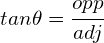
To determine the resultant force:






Then we solve the angle, 

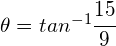

Therefore, the resultant force is 17.49N at an angle of 59.04° in the east direction above the horizontal.